


Somewhere in your late forties, the readers start multiplying: one pair at the desk, one in the car, one lost in the house. Refractive lens exchange (RLE), also called lens replacement surgery, replaces the eye’s natural lens with an artificial lens implant to correct your glasses prescription, including the near focus that starts slipping in the mid-40s. It’s the same operation as cataract surgery, done before a cataract ever forms, and we evaluate patients for it at our Irvine office, serving all of Orange County.

Why Your Reading Vision Changes After 45 (Presbyopia)
Your reading vision changes after 45 because of presbyopia, the natural stiffening of the lens inside your eye. That lens spent decades flexing to move focus between far and near. As it stiffens, near focus slips, and readers or progressives become part of daily life whether you were nearsighted, farsighted, or never wore glasses at all. Glasses compensate for the lens without changing what’s happening to it, which is why the prescription keeps climbing. Eye doctors sometimes call this stage dysfunctional lens syndrome, because presbyopia and cataract are the same lens aging on one continuum: the lens that has stiffened in your forties is the same one that will eventually cloud in your sixties or seventies. RLE, sometimes called clear lens exchange when it’s done before any cataract exists, replaces that lens early.
RLE vs. LASIK After 45
LASIK and RLE fix different parts of the eye. LASIK reshapes the cornea, the clear window at the front, and it works well when the cornea is where the problem is. Presbyopia is a lens problem, and no corneal procedure stops the lens from stiffening or, eventually, clouding. If you already need reading glasses, LASIK also corrects each eye for just one distance. You may still need to wear readers afterward, or do something called monovision, with one eye set for far and one set for near. With refractive lens exchange, some of the newer lens implants let both eyes see far and close. And a patient who gets LASIK at 48 still faces cataract surgery down the road; RLE removes that lens, so it can’t cloud into a cataract. One thing to know: some patients later develop a haze on the membrane behind the implant (doctors call it posterior capsule opacification). It isn’t a new cataract, and a quick in-office laser treatment typically clears it. For some patients in this age range, LASIK is still the right call.
Lens Implant Options for RLE
The implant you choose shapes what your vision is like afterward, so lens selection gets more attention than any other part of the process. You’ll sometimes see this whole category marketed as custom lens replacement; the “custom” part is real, because the lens is chosen from your measurements and your goals.
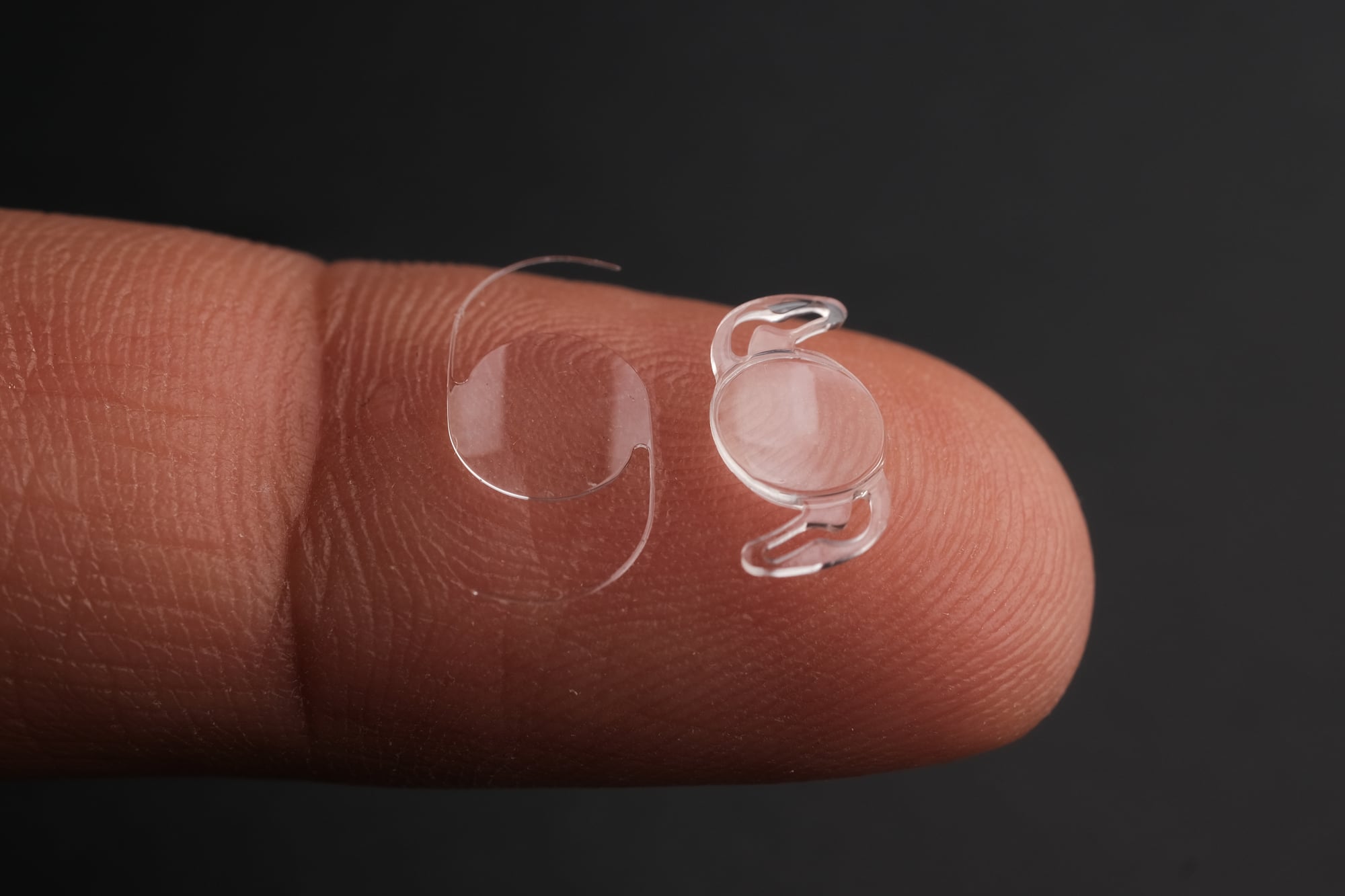
Monofocal Lens
A monofocal lens is set for one distance, usually far. Vision is sharp where it’s focused, and you wear readers for near work. It’s the simplest option, and plenty of patients pick it and are glad they did. A toric lens is a monofocal lens that can sharpen up vision if you have astigmatism.
Extended Depth of Focus (EDOF) Lens
An extended depth of focus (EDOF) lens such as the PureSee stretches clear vision from distance through arm’s length, the dashboard, the computer, a phone held out a bit. Fine print may still want readers.
Trifocal Lens
A trifocal lens such as the PanOptix Pro splits light between distance, intermediate, and near, covering all three ranges. Some patients notice rings or halos around lights at night. Most adapt over weeks to months; a small number don’t, and we tell you that before you choose it.
Light Adjustable Lens (LAL)
The Light Adjustable Lens (LAL) is the only implant whose prescription can be changed after surgery. Once your eyes have healed, we fine-tune the power with a short series of office light treatments, then lock it in. It asks more of your calendar: several visits over a couple of months, and UV-protective glasses worn until lock-in.
Astigmatism, an unevenly curved cornea that blurs vision at any distance, can be corrected as part of surgery, with toric versions of these lenses or, with the LAL, through its adjustments.
No lens wins on every measure. The right choice comes down to how you spend your day: what you read, what you drive, what’s on your desk. That’s what the lens conversation at a consultation is for.
Frequently Asked Questions
RLE Consultations in Irvine and Orange County
A consultation includes a full set of eye measurements, a straight answer on whether you’re a candidate, and, if you are, a lens recommendation built around your day. Call our Irvine office at (949) 653-9500 to schedule.
Medically reviewed by Todd Driver, MD, board-certified ophthalmologist, OC Eye Associates, Irvine, CA.